


Editorial Disclaimer: MIETCLG is an independent news and information website, not a college, university, or government organisation. We strive for accuracy, but readers should verify important details with official sources.
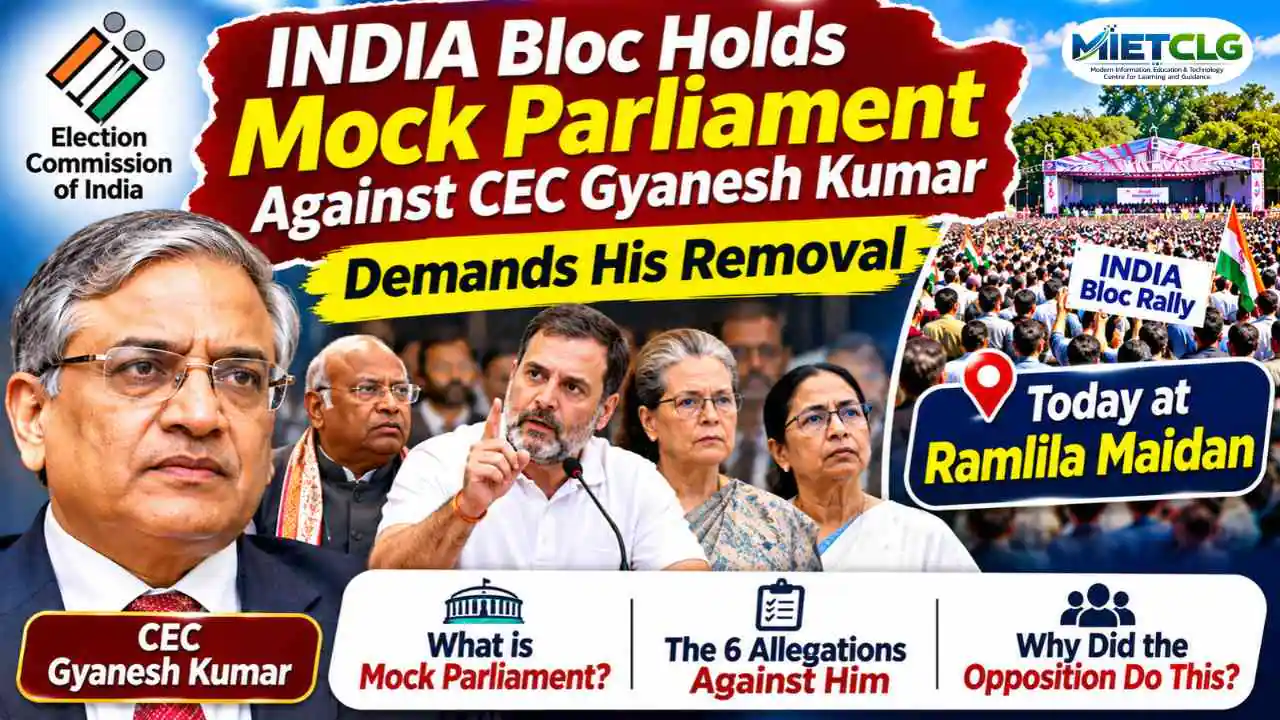
The political confrontation between the Opposition INDIA bloc and the Election Commission of India has intensified over allegations of electoral irregularities and the Special Intensive Revision (SIR) of voter lists. On Saturday, October 31, Opposition leaders organised a symbolic ‘Public Impeachment’ programme against Chief Election Commissioner (CEC) Gyanesh Kumar at Congress president Mallikarjun Kharge’s residence in New Delhi.
The event was organised in the format of a mock Parliament, where Opposition leaders discussed allegations against the Chief Election Commissioner and passed a symbolic resolution demanding his removal. The programme lasted around three and a half hours and was attended by several leaders and representatives of Opposition parties.
Following Saturday’s programme, the INDIA bloc has planned a major protest march and public rally at Delhi’s Ramlila Maidan on Sunday, November 1, under the slogan ‘Vote Bachao, Desh Bachao’.
The Opposition says the campaign is aimed at raising concerns over voter-list revisions, alleged deletion of voters’ names and the neutrality of the Election Commission. However, the symbolic proceedings held on Saturday do not constitute a formal constitutional impeachment or removal process.
Read More: Punjab Elections 2027: AAP Announces 40 Candidates in First List, Bhagwant Mann to Fight from Dhuri
What Is a Mock Parliament?
A mock Parliament is a simulated parliamentary session organised outside the actual Parliament. It follows a format similar to parliamentary proceedings, including a presiding officer, motions, speeches, discussions, debates and voting.
Such events are generally organised to demonstrate a political position, discuss public issues or draw attention to a particular demand. Participants recreate parliamentary proceedings to present their arguments before the public.
In this case, the INDIA bloc organised a symbolic parliamentary session to present its allegations against Chief Election Commissioner Gyanesh Kumar and demand his removal.
It is important to understand that a mock Parliament has no constitutional or legal authority. A resolution passed during such an event cannot remove a constitutional office-holder or replace the formal procedures laid down by the Constitution of India.
What Happened During the October 31 Mock Parliament?
The INDIA bloc’s symbolic Public Impeachment programme was held at the official residence of Congress president Mallikarjun Kharge, located at 10 Rajaji Marg in New Delhi.
The programme was originally scheduled for October 30 but was postponed by a day because of rain in the national capital. The proceedings began on October 31, with former Lok Sabha Speaker Meira Kumar presiding over the session.
The major developments during the programme included:
- Former Lok Sabha Speaker Meira Kumar presided over the symbolic proceedings.
- Mallikarjun Kharge initiated the motion against Chief Election Commissioner Gyanesh Kumar.
- Opposition leaders from different political parties presented their arguments and allegations.
- Representatives of civil society and people who claimed to have faced difficulties during the SIR process also participated.
- Rahul Gandhi delivered the concluding remarks.
- The participants adopted the symbolic resolution through a show of hands.
According to media reports, representatives of several INDIA bloc parties attended the programme. The proceedings were designed to resemble a parliamentary discussion, although the event was held outside the official Parliament.
Why Did the Opposition Organise a Mock Parliament?
The main reason behind the programme is the Opposition’s continuing disagreement with the Election Commission over the revision of electoral rolls and the conduct of elections.
Opposition parties have repeatedly questioned the Election Commission’s handling of the Special Intensive Revision (SIR) process. They have alleged that the exercise could result in the deletion of names of eligible voters and have raised concerns about transparency and accountability.
The Opposition has also questioned the role of Chief Election Commissioner Gyanesh Kumar, alleging that the Commission has not adequately addressed its concerns.
The INDIA bloc says that the issue is not limited to one political party or one election. According to its leaders, the credibility of the electoral process and the right of eligible citizens to vote are at stake.
The allegations are contested political claims and should not be treated as established findings. The Election Commission has maintained that its decisions are unanimous.
What Is SIR and Why Has It Become a Major Political Issue?
SIR stands for Special Intensive Revision. It is a special exercise undertaken by the Election Commission to verify and update electoral rolls.
The process involves checking voter details, identifying entries that may require correction or deletion, and ensuring that eligible citizens are included in the electoral rolls.
The exercise is intended to improve the accuracy of voter lists. However, it has become a major political controversy because Opposition parties have raised concerns about the possible exclusion of genuine voters.
The INDIA bloc has alleged that a large number of names have been removed from electoral rolls during the revision process. It has demanded greater transparency, proper verification and safeguards to ensure that eligible voters are not deprived of their voting rights.
The Opposition has also called for clearer explanations regarding the procedures followed by election officials.
Six Allegations Raised Against Chief Election Commissioner Gyanesh Kumar
During the symbolic proceedings, Mallikarjun Kharge presented six major allegations against Chief Election Commissioner Gyanesh Kumar.
The allegations raised by the Opposition included:
1. Alleged manipulation of electoral processes
The Opposition accused the Chief Election Commissioner of failing to ensure complete neutrality in the conduct and management of elections. It alleged that electoral processes were being influenced in favour of the ruling BJP.
2. Alleged deletion of voters’ names
The Opposition raised concerns over the deletion of a large number of names during the Special Intensive Revision of electoral rolls. Kharge referred to an alleged figure of approximately 13.2 crore voters in the resolution. This figure represents the Opposition’s allegation and should not be interpreted as an independently verified number of eligible voters wrongly removed.
3. Alleged changes involving Form 6
Form 6 is used for applying for inclusion of a name in the electoral roll. The Opposition questioned changes relating to the form and the rules governing voter registration, alleging that the process had been altered without adequate parliamentary scrutiny.
4. Centralisation of voter-list management
The Opposition raised concerns about the use of digital systems, including ERONET and ECINET, in the management of electoral rolls. It alleged that the systems could lead to excessive centralisation of control and reduce the role of local electoral registration authorities.
5. Alleged exclusion of other Election Commissioners from decisions
The Opposition referred to reports claiming that the other two Election Commissioners had raised objections on several occasions regarding decisions connected with SIR and electoral-roll management.
6. Alleged influence of the Central Government
The Opposition accused the Chief Election Commissioner of failing to maintain independence from the Central Government. It alleged that decisions were being taken under the influence of the Prime Minister and the Union Home Minister.
These are allegations presented by the INDIA bloc. They have not been established as findings by a court or an independent inquiry. The Election Commission has maintained that its decisions were unanimous.
Why Was the Programme Held Outside Parliament?
One of the most important questions surrounding the event is why the Opposition chose to organise a mock Parliament instead of pursuing the matter inside the actual Parliament.
The INDIA bloc had earlier submitted notices seeking action against the Chief Election Commissioner. The notices were submitted on March 12, with 130 Lok Sabha MPs and 63 Rajya Sabha MPs signing the respective notices, according to reports.
However, the notices were rejected by the presiding authorities of the two Houses on April 6.
The Opposition subsequently decided to organise a public symbolic proceeding to present its allegations before citizens.
The venue also became an issue. The Opposition reportedly could not secure permission to organise the programme at venues such as the Constitution Club and Talkatora Stadium. The event was eventually held at Kharge’s residence.
Congress leaders described the programme as a way to continue their political and public campaign after their formal parliamentary notices were rejected.
The Wire reported that the Opposition intended the event to be a political exercise rather than a legal proceeding.
What Was Rahul Gandhi’s Position?
Rahul Gandhi participated in the symbolic proceedings and delivered the concluding remarks.
He has repeatedly accused the ruling establishment and the Election Commission of undermining the integrity of the electoral process. He has also argued that the concerns surrounding SIR and alleged voter deletions need to be addressed publicly.
The Congress and other INDIA bloc parties have used the slogan ‘Vote Bachao, Desh Bachao’ to bring the issue to the centre of the political debate.
The Opposition says that protecting the voting rights of citizens should be treated as a national issue rather than a matter involving only political parties.
What Is the BJP’s Response?
The BJP has criticised the Opposition’s decision to organise a mock Parliament and questioned the purpose of conducting a symbolic impeachment outside the actual parliamentary system.
Union Home Minister Amit Shah has challenged Rahul Gandhi and other Opposition leaders to discuss allegations of vote theft in Parliament.
Shah said that the BJP was prepared to discuss the issue in a special session of Parliament. He also accused the Opposition of avoiding parliamentary discussion and choosing street protests instead.
The BJP’s position is that allegations relating to electoral rolls should be discussed through appropriate parliamentary and institutional channels.
Thus, both sides have presented different positions. While the Opposition is demanding greater accountability from the Election Commission, the BJP has questioned the political approach adopted by the INDIA bloc.
Will Gyanesh Kumar Be Removed After the Mock Impeachment?
No. The symbolic resolution passed during the mock Parliament does not remove Gyanesh Kumar from the post of Chief Election Commissioner.
The removal of a Chief Election Commissioner is governed by constitutional provisions. Under Article 324(5) of the Constitution of India, the Chief Election Commissioner can be removed in the same manner and on the same grounds as a Supreme Court judge.
This requires a formal parliamentary process and the prescribed special majority in both Houses of Parliament. A political rally, public meeting or symbolic vote cannot replace this procedure.
Therefore, the resolution passed at Mallikarjun Kharge’s residence has political significance for the Opposition’s campaign but does not have the legal effect of removing the CEC.
INDIA Bloc’s ‘Chalo Delhi’ Rally at Ramlila Maidan Today
After the symbolic Public Impeachment programme on October 31, the INDIA bloc has planned another major event in the national capital on November 1.
The Opposition has called for a protest march and public rally at Ramlila Maidan under the slogan ‘Vote Bachao, Desh Bachao’.
According to the announced programme, the march is scheduled to begin around noon from the Minto Road–Connaught Place area and proceed towards Ramlila Maidan.
The rally is expected to bring together leaders and representatives of several Opposition parties, along with civil society groups, students and citizens who support the campaign.
Rahul Gandhi, Mallikarjun Kharge and other INDIA bloc leaders are expected to participate in the programme.
The Opposition wants to use the rally to highlight its concerns over SIR, alleged voter deletions and the independence of the Election Commission.
The actual attendance, speeches and final decisions of the rally will depend on the events taking place during the day.
What Is the Main Political Objective Behind These Two Programmes?
The two events are part of a wider political campaign by the INDIA bloc. Their objectives can be understood through several key points.
First, to raise public awareness: The Opposition wants to bring the issue of voter-list revision and alleged electoral irregularities to the attention of citizens across the country.
Second, to demand accountability: The INDIA bloc wants the Election Commission to respond to its allegations and explain the procedures followed during SIR.
Third, to press for the CEC’s removal: The Opposition has made the removal of Gyanesh Kumar a central demand of its campaign.
Fourth, to demonstrate Opposition unity: By bringing several parties together on a common platform, the INDIA bloc aims to show that the issue has support beyond a single political party.
Fifth, to take the campaign beyond Parliament: The mock Parliament and the Ramlila Maidan rally are intended to create public and political pressure through demonstrations, speeches and wider participation.
The BJP, however, argues that the Opposition should raise its concerns through parliamentary discussions and appropriate institutional procedures.
Conclusion
The INDIA bloc’s October 31 mock Parliament and the November 1 rally at Ramlila Maidan have brought the controversy surrounding Chief Election Commissioner Gyanesh Kumar and the SIR exercise back into the national political debate.
The symbolic Public Impeachment was an unusual form of political protest. It allowed Opposition leaders to present their allegations in a parliamentary-style setting and pass a resolution demanding the CEC’s removal.
However, the resolution has no constitutional or legal power to remove the Chief Election Commissioner.
The larger debate concerns the accuracy of electoral rolls, the protection of eligible voters’ rights, the independence of the Election Commission and public confidence in India’s electoral system.
Whether the Opposition’s campaign leads to any institutional response or further political developments remains to be seen. The statements made at the Ramlila Maidan rally and the Election Commission’s response will be important developments to watch.
