


Editorial Disclaimer: MIETCLG is an independent news and information website, not a college, university, or government organisation. We strive for accuracy, but readers should verify important details with official sources.
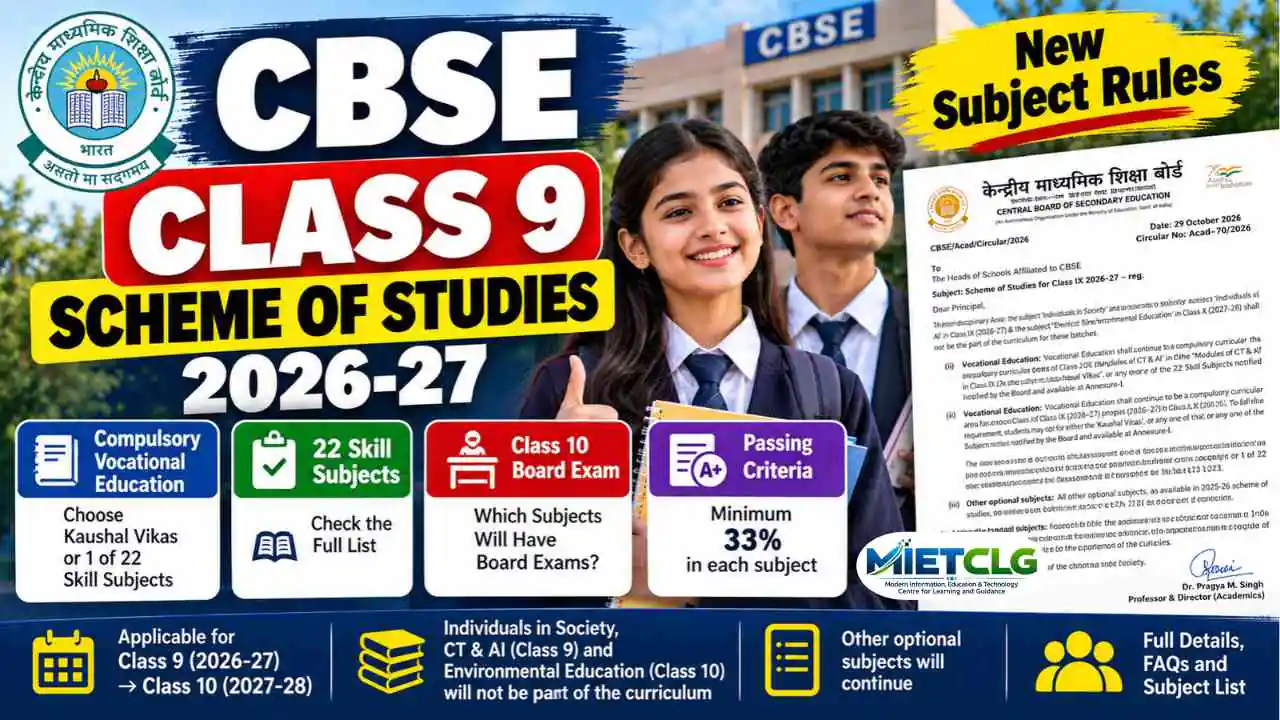
CBSE Class 9 Scheme of Studies 2026-27: The Central Board of Secondary Education (CBSE) has issued important instructions regarding the Scheme of Studies for Class 9 students for the academic session 2026-27 and their progression to Class 10 in 2027-28. The new guidelines clarify subject selection, compulsory vocational education, skill-based subjects, internal assessments, Class 10 board examinations, and passing criteria.
According to CBSE Circular No. Acad-70/2026, dated October 29, 2026, the Board has clarified how the revised curriculum arrangements will apply to students currently studying in Class 9 (2026-27) and moving to Class 10 (2027-28).
One of the most important provisions is that Vocational Education will remain a compulsory curricular area. Students will have the option to choose either Kaushal Vikas or one of the 22 skill subjects notified by CBSE.
The Board has also clarified that students choosing one of the 22 skill subjects will have to appear for the respective subject in the Class 10 Board Examination, whereas students choosing Kaushal Vikas will be assessed internally by their schools.
The circular also provides clarification on the subjects included in the Class 10 Board Examination, the minimum 33% passing requirement, subject replacement provisions, and special arrangements for Children with Special Needs (CwSN).
CBSE Class 9 and Class 10 New Rules 2026-27: Key Highlights
| Particulars | Details |
|---|---|
| Board | Central Board of Secondary Education |
| Circular Number | Acad-70/2026 |
| Circular Date | October 29, 2026 |
| Applicable Class | Class 9 (2026-27) |
| Progression | Class 10 (2027-28) |
| Compulsory Vocational Education | Yes |
| Vocational Options | Kaushal Vikas or one of 22 Skill Subjects |
| Total Regular Subjects | 9 |
| Optional Subject | One additional subject |
| Class 10 Passing Requirement | 33% in each of five Board-assessed subjects |
| Official Website | cbseacademic.nic.in |
Important: These provisions specifically apply to the Class 9 batch of 2026-27 progressing to Class 10 in 2027-28. CBSE has clarified that the existing scheme will continue for students already studying in Class 10 during the 2026-27 academic session.
1. Which Students Will Be Affected by the New CBSE Rules?
The latest circular applies to two connected academic sessions:
- Class 9 students studying during the 2026-27 academic session.
- The same batch of students when they progress to Class 10 during the 2027-28 academic session.
The new instructions will not apply to the current Class 10 batch of 2026-27. According to CBSE’s FAQ document, students currently studying in Class 10 during 2026-27 will continue under the previous scheme of studies.
This distinction is important because students, parents, and schools should not confuse the new provisions with the curriculum arrangements applicable to the existing Class 10 batch.
2. CBSE Removes Individuals in Society and CT & AI Modules for the Specified Batch
CBSE has clarified the implementation schedule for the Inter-disciplinary Area.
For students studying in Class 9 during 2026-27 and progressing to Class 10 in 2027-28, the following subjects and modules will not form part of their curriculum:
- Individuals in Society.
- Modules of CT & AI in Class 9.
- Environmental Education in Class 10.
The Board has clarified that these components will not be included in the curriculum for this particular batch in order to align the introduction of the interdisciplinary curricular area with the implementation schedule.
This is a batch-specific clarification and should not be interpreted as a general withdrawal of these subjects for all CBSE students.
3. Nine Subjects to Be Studied in Class 9 Under the New Scheme
According to the CBSE FAQ document attached to Circular Acad-70/2026, students in Class 9 during 2026-27 will be required to study the following nine subjects:
| Sl. No. | Subject |
|---|---|
| 1 | Language R1 |
| 2 | Language R2 |
| 3 | Mathematics |
| 4 | Science |
| 5 | Social Science |
| 6 | Language R3 |
| 7 | Art Education |
| 8 | Physical Education & Well-being |
| 9 | Vocational Education (Skill Education) |
In addition to these nine subjects, students may opt for one optional subject from the list prescribed by CBSE.
The optional language selected by a student must be different from the languages already chosen under R1, R2 and R3.
This structure aims to provide students with a combination of academic learning, language development, physical education, creative activities and vocational skills.
4. Vocational Education Made Compulsory: Students Can Choose Between 23 Options
One of the most significant provisions of the new CBSE circular is the continuation of compulsory Vocational Education for Class 9 students of 2026-27 and their Class 10 session in 2027-28.
Students can fulfil this requirement by choosing either:
- Kaushal Vikas.
- Any one of the 22 Skill Subjects notified by CBSE.
Therefore, students have a total of 23 available options under the vocational education category.
However, the assessment method will depend on the subject selected.
List of 22 CBSE Skill Subjects for 2026-27
As mentioned in Annexure-I of the official circular, the following 22 skill subjects are available:
| Sl. No. | Subject Name | Subject Code |
|---|---|---|
| 1 | Retail | 401 |
| 2 | Information Technology | 402 |
| 3 | Security | 403 |
| 4 | Automotive | 404 |
| 5 | Introduction to Financial Markets | 405 |
| 6 | Introduction to Tourism | 406 |
| 7 | Beauty & Wellness | 407 |
| 8 | Agriculture | 408 |
| 9 | Food Production | 409 |
| 10 | Front Office Operations | 410 |
| 11 | Banking & Insurance | 411 |
| 12 | Marketing & Sales | 412 |
| 13 | Health Care | 413 |
| 14 | Apparel | 414 |
| 15 | Multi Media | 415 |
| 16 | Multi Skill Foundation Course | 416 |
| 17 | Artificial Intelligence | 417 |
| 18 | Physical Activity Trainer | 418 |
| 19 | Data Science | 419 |
| 20 | Electronics and Hardware | 420 |
| 21 | Foundation Skills for Sciences (Pharmaceutical and Biotechnology) | 421 |
| 22 | Design Thinking and Innovation | 422 |
The list includes subjects related to technology, healthcare, business, finance, agriculture, manufacturing, hospitality and other professional fields.
Students should consult their respective schools to understand which of these subjects are available for selection.
5. Kaushal Vikas vs 22 Skill Subjects: What Is the Difference?
CBSE has clarified an important difference between Kaushal Vikas and the other 22 Skill Subjects.
Although both options fulfil the compulsory vocational education requirement, their assessment procedures are different.
| Particulars | Kaushal Vikas | 22 Skill Subjects |
|---|---|---|
| Compulsory Vocational Requirement | Yes | Yes |
| Class 10 Board Examination | No | Yes |
| Assessment Method | School-based Internal Assessment | CBSE Board Examination |
| Certificate | Issued by the school | Board marksheet and NSQF certificate for successful candidates |
If a Student Chooses Kaushal Vikas
Students selecting Kaushal Vikas will not have to appear for a separate CBSE Board Examination in this subject in Class 10.
Instead, the school will conduct the internal assessment and award marks and corresponding grades.
Students securing at least 33% marks will receive a certificate issued by their respective schools.
If a Student Chooses Any One of the 22 Skill Subjects
Students selecting any one of the 22 notified skill subjects will have to appear for the respective subject in the Class 10 Board Examination during 2027-28.
The marks and grades obtained in the skill subject will be reflected in the Board-issued marksheet.
Additionally, students who successfully pass the Board Examination in the selected skill subject will receive an NSQF certificate.
This is an important decision for students and parents because choosing a skill subject will involve an additional Board Examination, whereas Kaushal Vikas will be assessed internally by the school.
6. Which Subjects Will Have CBSE Class 10 Board Examinations in 2027-28?
CBSE has clarified the subjects that will be assessed through Board Examinations for the Class 9 batch of 2026-27 when they progress to Class 10.
The five compulsory Board-examination subjects are:
- Language R1.
- Language R2.
- Mathematics.
- Science.
- Social Science.
Apart from these five subjects, additional Board Examinations will be applicable depending on the optional subjects selected by students.
The following subjects will also have Board Examinations wherever applicable:
- Mathematics Advanced, if selected.
- Science Advanced, if selected.
- One optional subject, if selected.
- Any one of the 22 Skill Subjects, if selected instead of Kaushal Vikas.
Therefore, the number of subjects in which a student appears for Board Examinations may vary depending on the optional subjects chosen.
7. Which Subjects Will Have School-Based Internal Assessment?
Not every subject will have a separate CBSE Board Examination.
According to Table II of the circular, the following subjects will be assessed through school-based internal assessment in Class 10 during 2027-28:
| Subject | Assessment Method |
|---|---|
| Language R3 | School-based Internal Assessment |
| Art Education | School-based Internal Assessment |
| Physical Education & Well-being | School-based Internal Assessment |
| Kaushal Vikas | School-based Internal Assessment |
The optional subject will have both school-based internal assessment and Board Examination.
Similarly, the two main languages, Mathematics, Science and Social Science will have internal assessment as well as Board Examination.
The assessment arrangements are intended to distinguish between subjects requiring Board-level evaluation and those assessed at the school level.
8. CBSE Class 10 Passing Criteria 2027-28: Minimum 33% Marks Required
CBSE has clarified the passing criteria for students appearing in the Class 10 Board Examination in 2027-28 under this scheme.
To be declared pass in the Class 10 Board Examination, students must secure at least 33% marks in each of the five subjects assessed by the Board.
These five subjects are:
- Language R1.
- Language R2.
- Mathematics.
- Science.
- Social Science.
An important clarification is that the 33% requirement will be calculated by combining the Board Examination marks and Internal Assessment marks.
Example of the 33% Passing Rule
CBSE has provided an example in its FAQ document.
Suppose a student obtains:
| Assessment | Marks Obtained |
|---|---|
| Board Examination | 24 out of 80 |
| Internal Assessment | 9 out of 20 |
| Total | 33 out of 100 |
In this case, the student will be declared pass in that subject because the combined marks are 33 out of 100.
Therefore, students do not necessarily need to secure 33% separately in the written Board Examination, provided they obtain the required 33% aggregate marks from the Board Examination and Internal Assessment combined.
9. Subject Replacement Rules in CBSE Class 10 Board Examination
Another important provision in the new circular concerns subject replacement.
CBSE has explained two situations in which a student may be allowed to replace a failed subject with another subject.
Case 1: Replacement Through a Skill Subject
If a student chooses one of the 22 Skill Subjects under Vocational Education and secures less than 33% marks in any one of the following three subjects:
- Mathematics.
- Science.
- Social Science.
But successfully passes the selected Skill Subject, the skill subject may replace the failed subject for computation of the Class 10 Board Examination result.
For example, if a student fails in Mathematics but passes the selected Artificial Intelligence skill subject, the skill subject may replace Mathematics under the prescribed provision.
However, this replacement facility is not available to students who choose Kaushal Vikas instead of one of the 22 Skill Subjects.
Case 2: Replacement Through an Optional Language
A student who selects an additional language as an optional subject may also be eligible for subject replacement.
If the student secures less than 33% marks in either Language R1 or Language R2 but passes the optional language, the optional language may replace the failed language for computation of the Class 10 Board Examination result.
The optional language must be different from the languages already selected under R1, R2 and R3.
These replacement provisions are important because they provide additional academic flexibility to eligible students.
10. Grading System for Art Education and Physical Education
CBSE has also clarified how students will be graded in Art Education and Physical Education & Well-being (PE&WB).
Schools will award grades rather than numerical marks for these two subjects through school-based internal assessment.
The grading criteria are as follows:
| Marks Range | Grade |
|---|---|
| 91–100 | A1 |
| 81–90 | A2 |
| 71–80 | B1 |
| 61–70 | B2 |
| 51–60 | C1 |
| 41–50 | C2 |
| 33–40 | D |
| Below 33 | E |
Schools will issue their own certificates to students securing Grade D or above in these subjects.
For Kaushal Vikas, schools will award both marks and corresponding grades. Students must secure at least 33% marks to receive the school-issued certificate.
11. Optional Subjects Available for CBSE Class 9 Students
Apart from the nine regular subjects, CBSE allows students to select one additional optional subject from the prescribed list.
According to the FAQ document, the Board has listed 57 optional subjects.
These include different languages, music, arts, computer-related subjects and commerce-related subjects.
Some of the available optional subjects include:
- Bengali
- Hindi
- English
- Sanskrit
- Urdu
- Assamese
- Gujarati
- Punjabi
- Marathi
- Tamil
- Telugu
- Malayalam
- French
- German
- Japanese
- Arabic
- Spanish
- Painting
- Home Science
- National Cadet Corps (NCC)
- Computer Applications
- Elements of Business
- Elements of Bookkeeping & Accountancy
- Carnatic Music
- Hindustani Music
The complete list is provided in the CBSE circular’s FAQ section on pages 5–7.
Students selecting a language as their optional subject must ensure that it is different from their existing R1, R2 and R3 languages.
12. Special Provisions for Children with Special Needs (CwSN)
CBSE has also provided special subject-selection arrangements for Children with Special Needs (CwSN).
According to the circular, these students will have to study one compulsory language that will have a Board Examination.
The remaining four subjects for the Board Examination can be selected from the following options:
- Mathematics.
- Science.
- Social Science.
- Any other language from the CBSE-prescribed list, different from the language already selected.
- Music, including Carnatic or Hindustani Music.
- Painting.
- Home Science.
- Elements of Business.
- Elements of Book Keeping & Accountancy.
- Computer Applications.
- A maximum of two Skill Subjects from the list of 22 notified subjects, except Automotive.
- CBSE has also clarified that Information Technology, Computer Applications and Artificial Intelligence cannot be selected together under these provisions.
These arrangements provide additional flexibility in subject selection for eligible CwSN students.
13. What Should Schools Do Under the New CBSE Guidelines?
The circular has been issued to the Heads of Schools affiliated with CBSE, with instructions to disseminate the information among students and other stakeholders.
Schools should carefully review the updated Scheme of Studies, assessment tables and FAQs before finalising subject choices for the applicable batch.
The following areas require particular attention:
- Inform students and parents about compulsory Vocational Education.
- Explain the difference between Kaushal Vikas and the 22 Skill Subjects.
- Communicate which subjects will have Board Examinations in Class 10.
- Explain the internal assessment requirements.
- Guide students regarding optional subject selection.
- Follow the prescribed passing and subject replacement criteria.
- Make appropriate arrangements for students with special needs.
Schools should ensure that students and parents understand the assessment implications before selecting their vocational and optional subjects.
14. Important Changes at a Glance: Class 9 (2026-27) to Class 10 (2027-28)
The following table summarises the major provisions of the new CBSE circular.
| Topic | New CBSE Provision |
|---|---|
| Applicable batch | Class 9 (2026-27) |
| Class 10 session | 2027-28 |
| Total regular subjects | 9 |
| Additional optional subject | 1 |
| Vocational Education | Compulsory |
| Vocational options | Kaushal Vikas or 1 of 22 Skill Subjects |
| Compulsory Board subjects | 5 |
| Kaushal Vikas assessment | School-based |
| Skill Subject assessment | Class 10 Board Examination |
| Minimum passing marks | 33% aggregate in each of five Board subjects |
| Subject replacement | Available under specified conditions |
| Current Class 10 (2026-27) | Existing scheme continues |
15. Where to Download the Official CBSE Circular?
Students, parents, teachers and school administrators can access the official CBSE circular through the Board’s academic website.
Important documents and links:
- Official Circular: Download CBSE Circular Acad-70/2026 (PDF)
- CBSE Academic Website: Visit CBSE Academic Portal
- Latest CBSE Circulars: Check Latest Circulars
- CBSE Skill Education: Visit Skill Education Section
The 11-page circular dated October 29, 2026, contains the main notification, Annexure-I listing 22 skill subjects, assessment tables, and 12 frequently asked questions.
Frequently Asked Questions (FAQs)
1. Which students will be covered under CBSE Circular Acad-70/2026?
The guidelines apply to students studying in Class 9 during 2026-27 who will progress to Class 10 in 2027-28.
2. Is vocational education compulsory for CBSE Class 9 students?
Yes. Vocational Education is a compulsory curricular area. Students can choose either Kaushal Vikas or any one of the 22 notified Skill Subjects.
3. How many skill subjects are available under CBSE Vocational Education?
CBSE has notified 22 Skill Subjects, along with Kaushal Vikas as an alternative.
4. Will Kaushal Vikas have a Class 10 Board Examination?
No. Kaushal Vikas will be assessed through school-based internal assessment. Schools will issue certificates to students securing at least 33% marks.
5. Will Artificial Intelligence have a Board Examination?
Yes. Artificial Intelligence (Subject Code 417) is one of the 22 Skill Subjects. Students choosing it will have to appear for its Class 10 Board Examination.
6. How many subjects will students have to study?
Students will study nine regular subjects and may select one additional optional subject.
7. Which five subjects will have compulsory Class 10 Board Examinations?
Language R1, Language R2, Mathematics, Science and Social Science.
8. What are the minimum passing marks for Class 10?
Students must secure at least 33% aggregate marks in each of the five Board-assessed subjects, combining internal assessment and Board Examination marks.
9. Can a skill subject replace Mathematics, Science or Social Science?
Yes. If a student selects one of the 22 Skill Subjects, passes that subject and fails in one of Mathematics, Science or Social Science, the skill subject can replace the failed subject under the prescribed rules.
10. Can an optional language replace a failed language?
Yes. An optional language may replace either Language R1 or R2 if the student passes the optional language and fails in one of those two languages, subject to CBSE conditions.
11. Will the new rules apply to students currently studying in Class 10 during 2026-27?
No. CBSE has specifically clarified that the existing scheme will continue for the current Class 10 batch.
12. Will Environmental Education be included in Class 10 in 2027-28?
No. Environmental Education will not be part of the curriculum for the Class 9 batch of 2026-27 progressing to Class 10 in 2027-28.
Conclusion
The CBSE Circular Acad-70/2026 introduces important clarifications to the Scheme of Studies for students entering Class 9 in the 2026-27 academic session and progressing to Class 10 in 2027-28.
The continuation of compulsory Vocational Education is one of the most significant provisions. Students will have the flexibility to choose between Kaushal Vikas and 22 skill-based subjects covering areas such as Artificial Intelligence, Data Science, Information Technology, Healthcare, Electronics and Hardware, Agriculture and Financial Markets.
The Board has also clarified the five compulsory Class 10 Board Examination subjects, internal assessment arrangements, 33% passing requirement and subject replacement provisions.
For schools, teachers, parents and students, understanding these changes is important before finalising subject choices and assessment arrangements.
Students and parents should carefully review the official circular and consult their respective schools to understand the available subject combinations and examination requirements.
