


Editorial Disclaimer: MIETCLG is an independent news and information website, not a college, university, or government organisation. We strive for accuracy, but readers should verify important details with official sources.
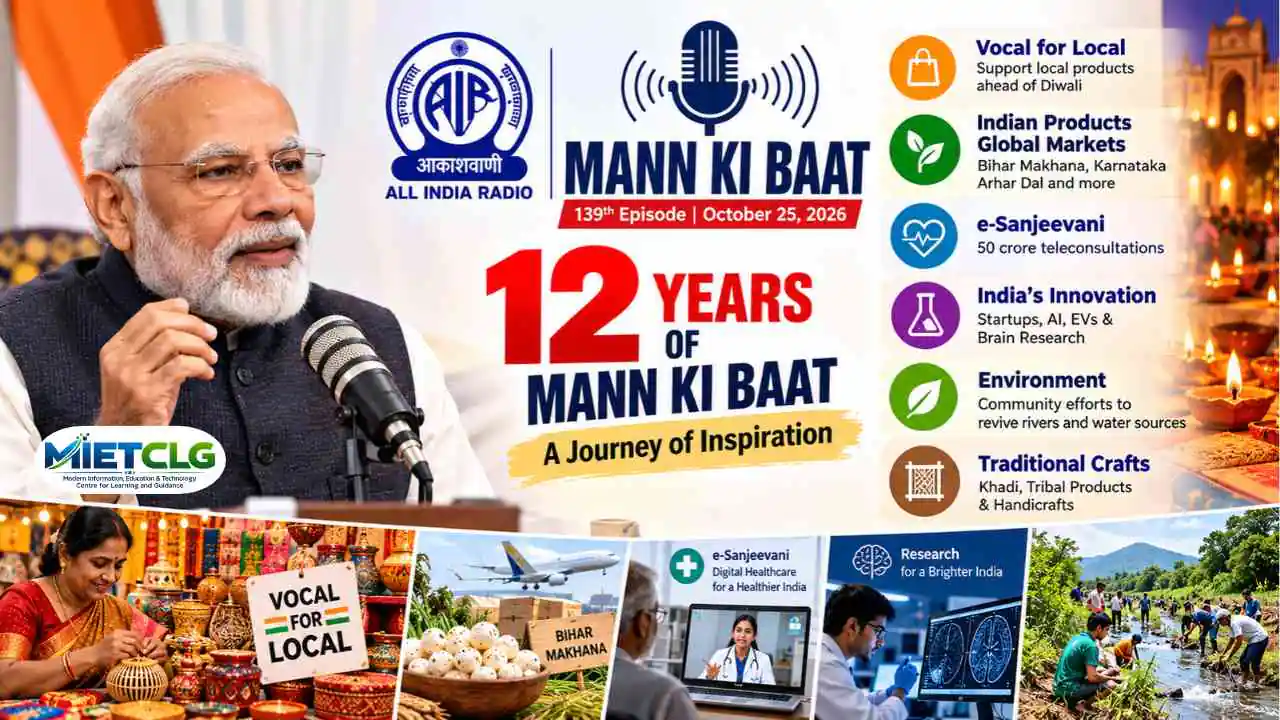
Mann Ki Baat October 2026: Prime Minister Narendra Modi marked 12 years of his monthly radio programme Mann Ki Baat on Sunday, October 25, 2026, using the occasion to highlight grassroots achievements, promote locally made products and share stories of innovation from across India. During the 139th episode, he urged citizens to strengthen the “Vocal for Local” movement ahead of Diwali and other upcoming festivals.
Broadcast on Akashvani, the programme featured examples of Indian agricultural products reaching international markets, community-led environmental conservation, advances in digital healthcare and scientific research, and efforts to preserve traditional skills. The Prime Minister also encouraged people to celebrate festivals responsibly, maintain cleanliness and support local artisans and entrepreneurs.
According to the official report published by News On AIR, Modi described his 12-year journey with Mann Ki Baat as an opportunity to understand the efforts of ordinary citizens and recognise their contributions to society. The programme began on Vijayadashami in 2014 and has continued as a monthly radio address.
Mann Ki Baat Completes 12 Years
Reflecting on the programme’s journey, Modi said that listeners had been fellow travellers and guides throughout the years. He described Mann Ki Baat as an opportunity to celebrate the hard work, courage, dedication and spirit of service demonstrated by people across the country.
The Prime Minister said the programme had helped him connect with families and communities in different parts of India. He also highlighted the contributions of people who work for society and the nation, often without widespread public recognition.
The 139th episode focused on the achievements of individuals, local communities, farmers, artisans, researchers and entrepreneurs. Their experiences illustrated how traditional knowledge, community participation and modern technology can contribute to social and economic development.
PM Modi Urges Citizens to Strengthen Vocal for Local
Ahead of Diwali, Modi called on citizens to prioritise products made by local artisans and producers while shopping for the festive season.
The Prime Minister said the growing interest in indigenous products was helping Indian goods reach international markets. He highlighted examples of agricultural produce and traditional products finding customers beyond India.
He also emphasised that product quality and packaging both matter when businesses seek to reach new markets. Attractive packaging that reflects a product’s cultural identity, he said, can help local enterprises present their products to a wider audience.
The appeal was linked to the broader idea of Atmanirbhar Bharat, or a self-reliant India. Supporting local producers during the festive season, according to the message shared in the programme, can help artisans, farmers and small businesses sustain their livelihoods.
Bihar Makhana and Karnataka Arhar Dal Reach International Markets
One of the key highlights of the address was the growing international reach of Indian agricultural products.
Modi mentioned that makhana from Purnia in Bihar was reaching Greece, while arhar dal from Kalaburagi in Karnataka was being exported to the Maldives. These examples illustrated how agricultural products associated with particular regions can find opportunities in overseas markets.
The Prime Minister noted that access to new markets can create additional opportunities for farmers and local producers. Better marketing, product presentation and distribution can help traditional products reach consumers beyond their home regions.
He also highlighted the importance of preserving local skills while creating new commercial opportunities. The message was that indigenous products can compete in wider markets when producers combine traditional knowledge with suitable packaging and market development.
Tribal Products Gain Recognition Through Innovative Packaging
Modi also referred to the efforts of tribal communities in Maharashtra to improve the presentation of their products.
Under the initiative known as Shabari Naturals, products such as honey, mahua, chironji and bamboo-based goods are being marketed using packaging inspired by tribal art and cultural traditions.
According to the Prime Minister’s address, the packaging received Japan’s Good Design Award. The example highlighted how design and cultural identity can add value to products made by local communities.
He also mentioned a bamboo-based start-up in Karnataka that is developing packaging materials using bamboo and agricultural residue.
These examples highlighted opportunities for local businesses to combine traditional resources with contemporary design and environmentally conscious materials.
Khadi Sales Cross ₹28 Crore in a Single Day
The Prime Minister highlighted the continued popularity of Khadi and its role in supporting artisans and traditional craftspeople.
According to his address, sales of Khadi Gram Udyog products crossed ₹28 crore on Gandhi Jayanti this year. This was an increase of ₹1.5 crore compared with the previous year.
Modi encouraged people to purchase products made by local artisans during the festive season. He said that supporting Khadi and handicrafts could help strengthen the Vocal for Local movement and contribute to the vision of a self-reliant India.
Khadi and other traditional products also provide livelihoods for people whose skills have been passed down through generations. Increased consumer demand can help sustain these crafts and create opportunities for their wider recognition.
Punjab Initiative Revives Traditional Cotton Farming and Weaving
The programme also highlighted an initiative in Punjab aimed at reviving organic farming and traditional agricultural practices.
The Kheti Virasat Mission has been working to promote natural cotton cultivation in the Malwa region under an initiative called Nav-Trinjan.
The project focuses on cultivating organic cotton using natural colours, reducing the need for additional chemicals in the dyeing process. It has also established a weaving school to help pass traditional weaving skills on to younger generations.
Modi mentioned the experiences of Ramandeep Kaur, Suneha Devi and Rajni Kaur, who have developed weaving skills and are using them to support their households.
He also recalled that a shawl woven by Rekha Rani had been presented to the President of India.
The initiative demonstrates how traditional crafts can create livelihood opportunities while encouraging more sustainable production practices.
Community Efforts Help Revive the Heval River
Environmental conservation was another important theme of the October episode.
Modi highlighted efforts by residents and the local administration in the Tehri Garhwal region of Uttarakhand to restore the Heval River and nearby natural water sources.
The campaign included rainwater harvesting, measures to improve groundwater recharge and the planting of trees. According to the Prime Minister, these efforts helped revitalise the river and supported the restoration of dozens of natural water sources.
The example underscored the importance of community participation in protecting rivers and preserving local ecosystems.
It also illustrated how relatively local initiatives can contribute to water conservation when residents, communities and administrative authorities work together.
e-Sanjeevani Records Around 50 Crore Teleconsultations
The Prime Minister discussed the role of technology in improving access to healthcare through the government’s e-Sanjeevani telemedicine service.
He said that the platform had facilitated approximately 50 crore teleconsultations, allowing people to seek medical advice remotely.
During the address, Modi shared examples of patients in geographically distant areas who received assistance through the service. These included cases in the Andaman and Nicobar Islands, Lakshadweep, Ladakh and Nagaland.
The examples demonstrated how remote consultations can connect local healthcare workers and patients with experienced doctors, particularly where access to specialist medical services may be difficult.
Modi also referred to the network of Ayushman Arogya Mandirs across the country, saying that these facilities were helping bring healthcare services closer to communities.
The examples highlighted the potential of digital technology to support healthcare delivery, although access to appropriate medical care continues to depend on local facilities, trained personnel and available specialist services.
IIT Madras Research Centre Focuses on Brain Imaging
Scientific research and technological innovation featured prominently in the programme.
Recalling his visit to Chennai earlier in October, Modi spoke about the Sudha Gopalakrishnan Brain Centre at IIT Madras. The centre has developed a brain-imaging technology platform designed to produce high-resolution digital 3D images of the human brain.
The project aims to map and study 100 human brains in detail, with the goal of supporting research into brain structure and related scientific questions.
The Prime Minister said the initiative uses the Param Shakti supercomputer and involves collaboration between industry, researchers, academic institutions and the government.
He also noted that data from the project was intended to be made available as an open-source resource for research across different fields.
Brain research is relevant to understanding neurological conditions, including Alzheimer’s disease and dementia. The project represents an effort to strengthen research infrastructure and expand scientific collaboration in India.
Organ Donation and Medical Research
Modi also spoke about organ donation and its importance in saving lives and supporting medical research.
He recalled the case of Shivani from Narmadapuram in Madhya Pradesh, whose family decided to donate her organs after she died following a road accident.
The Prime Minister praised the family’s decision and highlighted organ donation as an act that can help other patients and contribute to medical progress.
The example brought attention to the role families can play in organ donation and the importance of public awareness about donation procedures.
Start-ups Explore AI, Electric Vehicles and Financial Security
During his discussion of innovation at IIT Madras, Modi highlighted several start-ups working on emerging technologies.
The projects he mentioned included efforts to develop systems for verifying the quality of gold, platforms intended to help recover money lost through bank fraud, and the use of artificial intelligence to assist in cervical cancer screening.
Other teams were working on an electric vehicle capable of flying over the sea, faster-charging batteries for drones and electric vehicles, and applications of AI in defence technology.
The Prime Minister attributed such developments to the opportunities and support available to young researchers and entrepreneurs.
These examples reflect the range of fields in which Indian start-ups and research teams are exploring new applications of technology, from healthcare and finance to transport and defence.
Meghalaya and Nagaland Revive Traditional Millet Cultivation
The programme also highlighted efforts to revive millet cultivation and develop new products from traditional crops in the northeastern states.
In Khanduli village in Meghalaya’s West Jaintia Hills district, two women developed millet-based products such as cookies, cakes, muffins and baby food.
According to the address, these products helped increase demand for millets and encouraged renewed interest in cultivation.
Modi also mentioned Chekjing Sangma, a farmer from Sadolpara village in West Garo Hills, who adopted modern cultivation methods to grow millets and increase his income.
In Kezoma village in Nagaland’s Kohima district, local residents resumed millet cultivation in 2024 after it had stopped for more than a decade. The village held its first millet festival in 2025.
These examples showed how traditional crops can create new livelihood opportunities when farmers and communities explore value-added products and modern marketing approaches.
PM Modi Pays Tribute to Maharishi Valmiki and Bhai Parmanand
The Prime Minister also referred to important historical and cultural occasions.
Speaking about Maharishi Valmiki, whose birth anniversary falls on October 26, Modi highlighted the values of perseverance, service, compassion and social harmony reflected in the Ramayana.
He referred to the stories of Lord Ram, Mata Shabari and Nishadraj as examples of devotion, friendship and respect for others.
Modi also spoke about the upcoming 150th birth anniversary of freedom fighter and educationist Bhai Parmanand on November 4. He recalled Parmanand’s role in the freedom movement, his association with the Ghadar Party and his experiences during imprisonment under British rule.
The Prime Minister encouraged young people to learn about the lives and contributions of historical figures and freedom fighters.
Run for Unity and National Integration
The address also referred to the birth anniversary of Sardar Vallabhbhai Patel on October 31, which is observed as National Unity Day, or Ekta Diwas.
Modi encouraged citizens to participate in the annual Run for Unity, describing it as an opportunity to reaffirm their commitment to national unity.
The programme connected the observance with the broader importance of public participation, shared responsibility and respect for the country’s diverse communities.
Cleanliness and Safe Festive Celebrations
As Diwali and Chhath approach, Modi urged people to celebrate safely and maintain cleanliness in their homes and surroundings.
He noted that cleanliness campaigns were taking place in different areas ahead of the festivals and encouraged individuals to contribute through small, everyday actions.
The message also included wishes for the upcoming festive season, with an emphasis on health, safety and sharing happiness with others.
What the October 2026 Mann Ki Baat Address Highlighted
The 139th episode brought together a wide range of themes: local enterprise, agricultural exports, traditional craftsmanship, environmental protection, digital healthcare, scientific research and community-led development.
The programme’s central message was that the efforts of ordinary citizens can contribute to broader social and economic change. From farmers and weavers to scientists and start-up founders, the examples highlighted how local knowledge and innovation can create opportunities across different sectors.
With Diwali approaching, the Prime Minister’s appeal to support local artisans and producers placed Vocal for Local at the centre of the festive message.
The episode also marked 12 years of Mann Ki Baat, a programme that has regularly featured stories of individuals and communities working in areas ranging from culture and conservation to technology and public service.
