


Editorial Disclaimer: MIETCLG is an independent news and information website, not a college, university, or government organisation. We strive for accuracy, but readers should verify important details with official sources.
Brahma AI in the Film Industry: Artificial Intelligence is gradually transforming the global entertainment industry. From creating realistic digital characters and advanced visual effects to translating movie dialogues and synchronising actors’ lip movements, AI is opening new possibilities for filmmakers.
One of the latest developments attracting attention is BRAHMA AI, an advanced AI-powered media technology platform being used in connection with the international release of India’s upcoming epic film Ramayana, starring Ranbir Kapoor, Sai Pallavi and Yash.
The technology is bringing a new dimension to movie dubbing by helping synchronise actors’ lip movements with dialogues in different languages. This could make international movie releases more natural and immersive for audiences.
But what exactly is BRAHMA AI? How does it work? Can it transform Bollywood and Hollywood filmmaking? And will artificial intelligence eventually replace professional dubbing artists?
Read More: Punjab Elections 2027: AAP Announces 40 Candidates in First List, Bhagwant Mann to Fight from Dhuri
Here is everything you need to know about BRAHMA AI and its growing role in the global film industry.
What Is BRAHMA AI?
BRAHMA AI is an enterprise artificial intelligence platform developed by Prime Focus Technologies, bringing together media technology and advanced AI capabilities.
The platform combines the expertise of Prime Focus Technologies and Metaphysic to support content creation, digital human technology, voice localisation, visual effects, and media management.
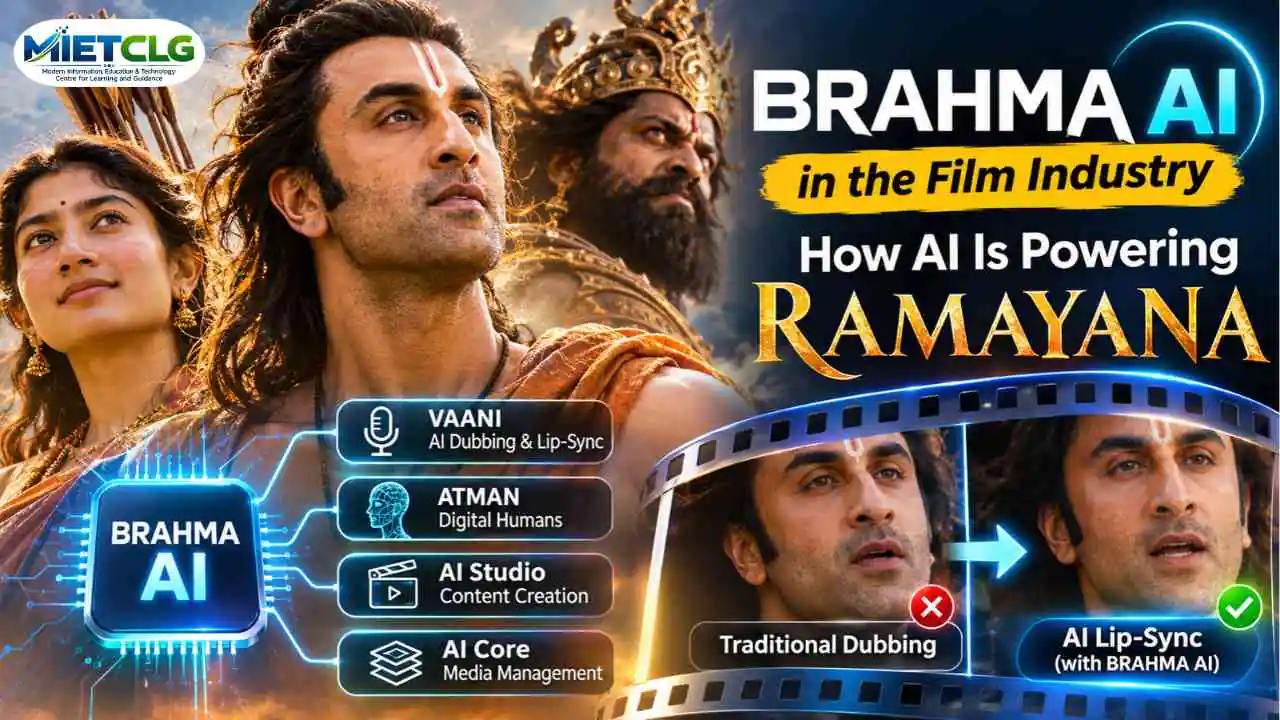
Its technology ecosystem includes several specialised solutions:
- VAANI: An AI-powered voice localisation technology designed to support multilingual content and synchronise facial and lip movements with translated dialogues.
- ATMAN: A digital human technology that enables the creation of realistic digital representations of people.
- BRAHMA AI STUDIO: A creative environment designed to support AI-powered content creation and enhancement.
- BRAHMA AI CORE: An enterprise platform for managing, organising, searching and distributing large volumes of digital media content.
The broader objective is to combine human creativity with artificial intelligence to make media production and distribution more efficient.
How Is BRAHMA AI Being Used in Ranbir Kapoor’s Ramayana?
The upcoming Ramayana, directed by Nitesh Tiwari, is one of the most ambitious Indian cinematic projects. The film is based on the ancient Indian epic and features a major cast.
The principal cast includes:
- Ranbir Kapoor as Lord Rama.
- Sai Pallavi as Goddess Sita.
- Yash as Ravana.
- Ravi Dubey as Lakshmana.
- Sunny Deol as Hanuman.
- Lara Dutta as Kaikeyi.
- Rakul Preet Singh as Surpanakha.
The film is produced by Namit Malhotra’s Prime Focus Studios in association with Monster Mind Creations.
One of the interesting aspects of its international distribution is the use of BRAHMA AI’s VAANI technology for English-language lip synchronisation.
Traditionally, when a Hindi film is dubbed into English, the actors’ original mouth movements remain unchanged. As a result, audiences may notice that the spoken English dialogue does not perfectly match the movements of the actors’ lips.
AI-assisted lip synchronisation aims to address this problem.
The technology can help adjust the visible mouth movements to match the translated dialogue while maintaining the original facial expressions and performance.
This could make the English-language version feel more natural to international viewers.
How Does AI Lip-Sync Technology Work?
AI-powered lip synchronisation combines voice processing, facial analysis and digital performance technology.
The process generally involves five stages:
1. Original Film Recording
Actors perform their scenes in the original language. Their facial expressions, body movements and dialogue delivery are recorded.
2. Multilingual Dialogue Recording
Professional voice artists translate and record the dialogues in the target language, such as English.
3. Facial Performance Analysis
AI technology analyses the relationship between the new dialogue, pronunciation and facial movements.
4. AI-Powered Lip Synchronisation
The technology adjusts the visible lip movements to correspond more closely with the new language.
5. Final Editing and Quality Control
Film editors and technical specialists review the output and make necessary corrections before incorporating it into the final movie.
The purpose is not to recreate the entire performance but to improve language synchronisation while retaining the original actor’s expressions and emotions.
Does AI Replace the Original Voices of Ranbir Kapoor, Sai Pallavi and Yash?
The use of AI in Ramayana has raised questions about whether the actors’ voices are being digitally cloned or replaced.
However, director Nitesh Tiwari clarified that AI was being used for lip synchronisation rather than replacing human dubbing artists.
The English dialogues were performed by human voice artists, while AI technology helped match the actors’ visible mouth movements with the new language.
This is an important distinction.
AI-assisted dubbing does not necessarily mean AI-generated voices or completely artificial acting. Professional voice artists, translators, directors, and editors continue to play important roles.
Five Ways AI Is Transforming the Film Industry
BRAHMA AI represents a wider technological development that could influence several areas of filmmaking.
1. AI-Powered Visual Effects
Visual effects are among the most expensive and time-consuming elements of modern cinema.
AI can assist production teams with digital face replacement, background enhancement, facial reconstruction, de-ageing and complex visual effects.
These technologies can reduce repetitive work and help filmmakers create sophisticated visual experiences.
2. Realistic Digital Human Creation
Digital human technology allows filmmakers to create realistic virtual characters.
These digital representations can potentially be used in movies, advertisements, television programmes, virtual production and interactive entertainment.
3. Multilingual Movie Dubbing
AI-assisted localisation can help filmmakers adapt movies for audiences speaking different languages.
A film originally produced in Hindi could be adapted for English-speaking audiences and viewers in other international markets.
Improved lip synchronisation can make these versions more immersive.
4. AI-Based Voice Localisation
Voice localisation involves adapting audio content for different languages and audiences.
AI can assist with speech processing, language adaptation and synchronisation, while professional artists ensure that the emotional quality of the performance is maintained.
5. Digital Content Management
Large production houses and OTT platforms manage enormous collections of video, audio and digital files.
AI-powered content management systems can help organise these archives, identify scenes and retrieve specific media assets more efficiently.
AI Is Already Making an Impact in Hollywood
The use of artificial intelligence in cinema is not limited to Indian productions.
Several international film productions have explored AI-assisted digital performance and visual effects.
- Here (2024): The film starring Tom Hanks and Robin Wright used AI-based facial transformation technology to portray characters at different stages of their lives.
- Furiosa: A Mad Max Saga: The wider visual effects technology ecosystem associated with AI-assisted production has been part of developments in modern Hollywood filmmaking.
- Alien: Romulus: The production also attracted attention for its use of advanced digital visual effects and technology-assisted filmmaking.
These developments demonstrate how artificial intelligence is becoming increasingly relevant to professional film production.
Will AI Replace Dubbing Artists and VFX Professionals?
The growing use of AI has created concerns among actors, dubbing artists, translators, video editors and visual effects professionals.
If AI can synchronise lips, modify faces, generate digital characters and process voices, some traditional production tasks may become less labour-intensive.
However, filmmaking requires much more than technical processing.
Professional artists contribute emotional depth, creative interpretation, storytelling and performance quality that cannot simply be reduced to automated tasks.
AI may change the nature of several creative professions rather than eliminate all human involvement.
Some potential changes include:
- Dubbing artists may increasingly work with AI-assisted localisation systems.
- Translators may focus more on cultural accuracy and emotional interpretation.
- VFX professionals may use AI to accelerate repetitive production tasks.
- Video editors may adopt AI-powered post-production workflows.
- Directors may gain additional tools for creative experimentation.
The industry must also establish clear protections for actors’ digital identities, voices, consent and intellectual property rights.
Is BRAHMA AI Limited to the Film Industry?
No. The platform has broader applications across different industries.
Its technologies can potentially support:
- OTT and Streaming Platforms: Multilingual content localisation and media management.
- Television and Broadcasting: Organising digital archives and preparing content for different audiences.
- Advertising: Creating multilingual promotional videos and digital presenters.
- Education: Developing digital educators and multilingual learning materials.
- Healthcare: Supporting digital communication and educational media.
- Sports: Managing and distributing large volumes of video content.
- Corporate Communication: Creating digital presentations and interactive content.
This makes BRAHMA AI a broader media and enterprise technology platform rather than simply a movie-dubbing solution.
BRAHMA AI’s Funding and Global Recognition
BRAHMA AI has also attracted attention in the technology and investment sectors.
In September 2026, the company announced a $150 million funding round involving a $100 million investment led by Multiples Alternate Asset Management. It also announced an additional $100 million of investor interest.
The company is pursuing opportunities across media and entertainment, sports, healthcare and advertising.
Another significant development came in September 2026, when BRAHMA AI announced that it had received a 2026 Technology & Engineering Emmy Award for its AI-based face replacement and performance-preserving post-production transformation technology.
The recognition was associated with its Neural Performance technology, which enables digital facial transformation while retaining important aspects of the original performance.
These developments highlight the growing commercial interest in AI-powered media production.
Challenges of Using Artificial Intelligence in Movies
Despite its potential, AI-powered filmmaking also raises important concerns.
- Digital Identity Protection: Actors must have control over how their faces, voices and digital likenesses are used.
- Copyright Issues: The ownership and permitted use of AI-generated material need clear legal frameworks.
- Employment Concerns: Increasing automation could affect some traditional creative jobs.
- Performance Quality: AI-generated facial movements must look natural and preserve the emotional depth of the original acting.
- Transparency: Production companies should communicate when AI is used to modify an actor’s appearance, voice or performance.
- Data Security: Digital face scans, voice recordings and performance data must be protected against unauthorised access.
Responsible adoption will be essential for the long-term development of AI in cinema.
What Does the Future Hold for AI in Cinema?
The use of BRAHMA AI in connection with Ramayana highlights an important possibility for Indian cinema: reaching international audiences through more advanced multilingual production technology.
India produces films in numerous languages, including Hindi, Bengali, Tamil, Telugu, Malayalam and Kannada.
AI-assisted localisation could help filmmakers distribute their work across international markets while reducing some of the technical limitations of traditional dubbing.
In the coming years, AI could play a growing role in digital character creation, visual effects, voice localisation, facial performance and post-production.
However, technology alone cannot create a successful film. Storytelling, acting, music, direction and human creativity will remain central to cinema.
The future of filmmaking may not be a competition between humans and artificial intelligence. Instead, it could be a combination of human creativity and intelligent technology, bringing movies closer to audiences across the world.
