
NCERT Class 10 New Textbooks 2027-28: New Books Expected by December 2026, Check Subject-Wise Release Schedule and Curriculum Changes

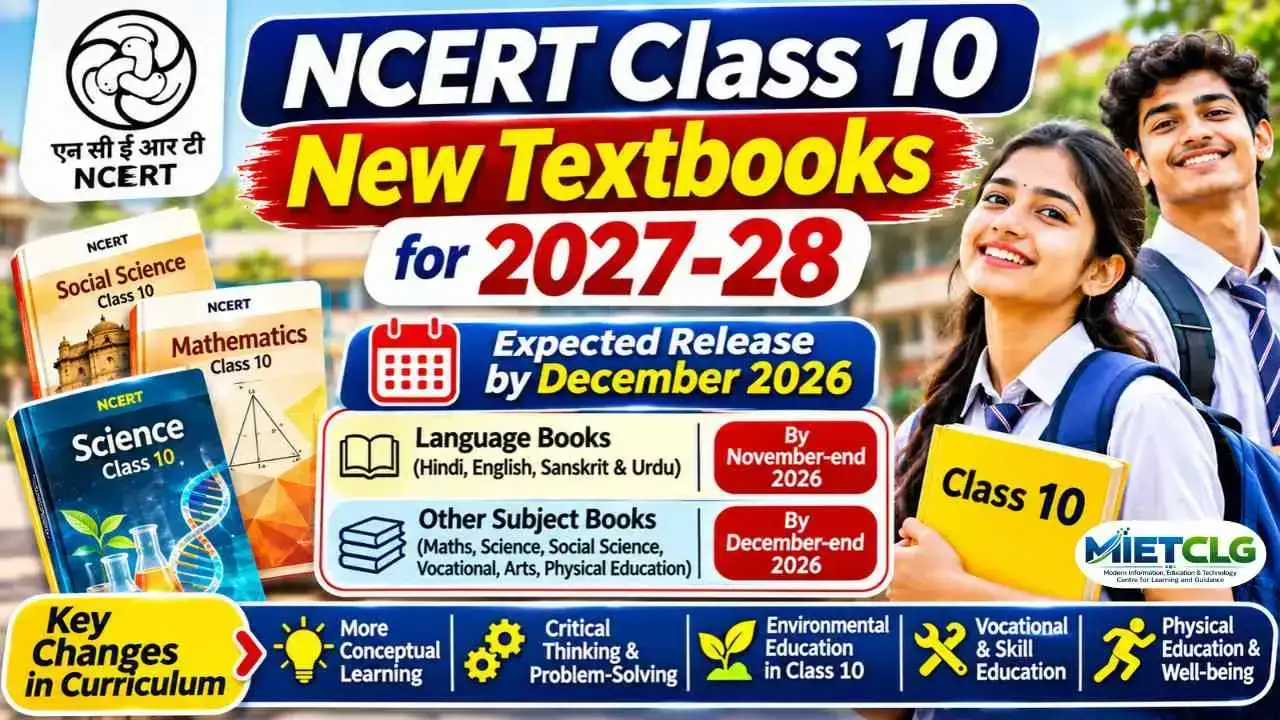
NCERT Class 10 New Books 2027-28: The National Council of Educational Research and Training (NCERT) is preparing to introduce revised textbooks for Class 10 students from the 2027-28 academic session. The new books are expected to be released in phases, with language textbooks likely to become available by the end of November 2026 and the remaining subject books expected by December 2026.
Table of Contents26 sections
- NCERT Class 10 New Textbooks 2027-28: Overview
- NCERT Class 10 Textbook Release Schedule 2026
- Which Subjects Will Be Covered in the New Class 10 Books?
- What Changes Can Students Expect in the New NCERT Class 10 Curriculum?
- 1. More Focus on Conceptual Understanding
- 2. Critical Thinking and Problem-Solving
- 3. Mathematics and Computational Thinking
- 4. Vocational Education
- 5. Arts Education
- 6. Physical Education and Well-being
- 7. Environmental Education in Class 10
- Why Is NCERT Introducing New Class 10 Books From 2027-28?
- What About the New Class 10 Syllabus?
- Will the Class 10 Board Examination Pattern Change?
- NCERT Plans Teacher Training Under Reimagined NISHTHA
- 1. Updated Classroom Teaching Methods
- 2. Competency-Based Learning
- 3. New Assessment Practices
- 4. Preparation of Teaching Resources
- What About Students Currently Studying in Class 9?
- Have NCERT New Books Already Been Introduced in Other Classes?
- How to Download NCERT Class 10 New Books 2027-28 Online?
- Where Can Students Buy the New NCERT Class 10 Books?
- How Will the New Books Help Teachers and Schools?
- What Should Students Do Now?
- Important Official Links
The revision is part of the implementation of the National Education Policy (NEP) 2020 and the National Curriculum Framework for School Education (NCF-SE) 2023. The changes aim to move classroom learning beyond memorisation, with greater attention to conceptual understanding, practical knowledge, critical thinking, creativity and skill development.
This update is particularly important for students currently studying in Class 9 who will enter Class 10 in the 2027-28 session. Teachers and parents will also need to understand the revised subject structure, new learning materials and changes in classroom assessment before the new academic year begins.
According to reports published on November 17, NCERT is planning a phased release of the books. However, the council has not yet published a final, confirmed subject-wise release calendar. The dates discussed below should therefore be treated as expected timelines, not guaranteed release dates.
NCERT Class 10 New Textbooks 2027-28: Overview
| Particulars | Details |
|---|---|
| Organisation | National Council of Educational Research and Training (NCERT) |
| New textbooks | Class 10 revised textbooks |
| Academic session | 2027-28 |
| Expected release | November–December 2026 |
| Language books | Expected by November end 2026 |
| Other subject books | Expected by December-end 2026 |
| Curriculum framework | NCF-SE 2023 |
| Education policy | NEP 2020 |
| Syllabus development | NCERT |
| Board affiliation | CBSE and other schools following the relevant NCERT curriculum |
| Official website | https://ncert.nic.in/ |
| Digital textbook platform | https://epathshala.nic.in/ |
NCERT Class 10 Textbook Release Schedule 2026
NCERT is expected to release the revised Class 10 textbooks in phases. This will help students and schools access the new study material before the 2027-28 academic session begins.
The expected schedule reported by education news organisations is as follows:
| Expected release period | Subjects |
|---|---|
| November-end 2026 | Hindi, English, Sanskrit and Urdu |
| December-end 2026 | Mathematics, Science, Social Science, Physical Education, Vocational Education, Art Education and other subjects |
Some earlier reports mentioned November 20 as the expected date for language textbooks. Other reports describe the timeline more broadly as the end of November.
Important: NCERT has not yet issued a final subject-wise release calendar confirming these dates. Students should check the official NCERT website for actual publication announcements.
Which Subjects Will Be Covered in the New Class 10 Books?
The revised Class 10 curriculum is being developed under NCF-SE 2023. The framework gives importance to a broader range of learning areas rather than focusing only on traditional textbook subjects.
The curriculum framework for Grades 9 and 10 identifies the following ten curricular areas:
- Language 1
- Language 2
- Language 3
- Mathematics
- Science
- Social Science
- Individuals in Society
- Vocational Education
- Arts Education
- Physical Education and Well-being
For Grade 10, the interdisciplinary area called Environmental Education is proposed in place of Individuals in Society.
This is an important feature of the revised curriculum. It allows students to understand environmental issues, sustainability, natural resources, and the relationship between human activities and the environment.
The exact subject titles, textbook structure, and assessment arrangements will become clearer when NCERT releases the final Class 10 syllabus and books.
What Changes Can Students Expect in the New NCERT Class 10 Curriculum?
The revised curriculum is intended to change how students learn and apply knowledge.
Instead of depending mainly on memorisation, the new framework gives greater attention to understanding concepts and using knowledge in practical situations.
1. More Focus on Conceptual Understanding
Students will be encouraged to understand why something happens rather than simply memorising definitions and answers.
For example, Science learning can involve understanding scientific principles and applying them to everyday situations.
2. Critical Thinking and Problem-Solving
The revised curriculum aims to develop students’ ability to analyse information, identify problems and find suitable solutions.
Mathematics and other subjects are expected to encourage reasoning and logical thinking.
3. Mathematics and Computational Thinking
Mathematics remains an important subject, with greater attention to logical reasoning, problem-solving and computational thinking.
Students will need to develop an understanding of mathematical concepts and their practical applications.
4. Vocational Education
Vocational Education is included as a separate curricular area.
The broader objective is to introduce students to practical skills and work-related learning. This may help students understand different occupations, skills and career possibilities.
5. Arts Education
Arts Education receives an important place in the revised curriculum.
Art, creativity and cultural activities are considered important parts of a student’s overall development.
6. Physical Education and Well-being
Physical Education and Well-being is included as a curricular area.
The focus is not limited to sports alone. It also relates to physical fitness, health, well-being and the development of healthy habits.
7. Environmental Education in Class 10
Environmental Education is particularly relevant to Class 10.
Students will have opportunities to learn about environmental protection, climate-related issues, conservation, sustainability and responsible use of natural resources.
The final chapter-wise content and learning outcomes will be known after the publication of the official textbooks.
Why Is NCERT Introducing New Class 10 Books From 2027-28?
The textbook revision is part of the larger education reform process under NEP 2020.
The National Curriculum Framework for School Education 2023 provides the academic direction for developing revised school syllabi, textbooks, and teaching methods.
The broad objectives include:
- Reducing excessive dependence on rote learning.
- Improving conceptual understanding.
- Encouraging critical and analytical thinking.
- Connecting classroom learning with real-life situations.
- Giving importance to vocational and practical skills.
- Promoting creativity and artistic development.
- Supporting physical and mental well-being.
- Encouraging interdisciplinary learning.
- Improving assessment practices.
The idea is to make school education more balanced and relevant to the needs of students.
What About the New Class 10 Syllabus?
The revised textbooks will follow the new curriculum framework. NCERT Director Dinesh Prasad Saklani was reported to have said that the Class 10 subject syllabi would be sent to CBSE by November 15, 2026, and made available through the NCERT website.
This was a reported target. Students should check the official websites to confirm the publication of the final syllabus.
The syllabus is important because it will explain:
- Subject-wise topics.
- Chapters and learning areas.
- Learning outcomes.
- Practical and project-related requirements.
- Assessment expectations.
- Academic guidelines for teachers and schools.
Students should avoid preparing from unofficial chapter lists until the final syllabus is published.
Will the Class 10 Board Examination Pattern Change?
The revised curriculum is expected to influence teaching and assessment practices.
NCF-SE 2023 recommends competency-based assessment, with greater attention to understanding, analysis, application and problem-solving.
This means that students may need to demonstrate how well they understand and use a concept, rather than only reproduce memorised answers.
However, students should not assume that a particular new CBSE question-paper pattern, marks distribution or examination structure has already been announced.
The final examination pattern, subject-wise marks distribution, internal assessment requirements and practical examination details must be checked in the official CBSE curriculum and examination notifications.
- CBSE official website: https://www.cbse.gov.in/
- CBSE Academic website: https://cbseacademic.nic.in/
NCERT Plans Teacher Training Under Reimagined NISHTHA
Introducing new textbooks is only one part of the curriculum revision. Teachers also need to understand the new learning approach and prepare suitable classroom activities.
For this purpose, NCERT is working on teacher training under its Reimagined NISHTHA initiative.
According to reports, the programme aims to train around 60 lakh teachers across 28 states and eight Union Territories. Around 60,000 Key Resource Persons (KRPs) are expected to support the training process.
The programme is intended to help teachers understand the revised curriculum and use the new textbooks effectively.
The major training areas include:
1. Updated Classroom Teaching Methods
Teachers will be introduced to teaching approaches suitable for the revised curriculum.
The objective is to encourage classroom discussion, exploration, practical activities and better student participation.
2. Competency-Based Learning
Teachers will be trained to help students understand concepts and apply their knowledge.
The focus is on learning outcomes rather than only completing chapters.
3. New Assessment Practices
Teachers will need to understand how to evaluate students’ learning, progress and practical understanding under the revised framework.
4. Preparation of Teaching Resources
Teachers may need to prepare lesson plans, classroom activities and learning materials according to the new textbooks.
The New Indian Express reported on November 12, 2026, that NCERT had trained more than 100 master trainers through a five-day capacity-building programme held from November 2 to 6 under Reimagined NISHTHA.
The training covered areas such as NEP 2020, NCF-SE, school leadership, digital education, game-based learning, inclusive education and assessment processes.
The larger teacher-training target and the reported master-trainer programme are part of the preparation for implementing the revised curriculum.
What About Students Currently Studying in Class 9?
The announcement is particularly important for students who are currently studying in Class 9.
These students are expected to enter Class 10 in the 2027-28 academic session and will therefore need to follow the revised Class 10 textbooks.
The early release of books is expected to provide several benefits:
- Students can become familiar with the new curriculum before the academic session begins.
- Teachers can review the revised chapters in advance.
- Schools can prepare lesson plans and academic schedules.
- Parents can understand the new subject structure.
- Students can identify topics requiring additional preparation.
- Schools can plan practical, project-based and interdisciplinary activities.
Students currently studying in Class 10 during the 2026-27 session should not assume that they need to switch to the new books immediately. The revised Class 10 books are intended for the 2027-28 academic session.
Have NCERT New Books Already Been Introduced in Other Classes?
Yes. The revised textbooks are being introduced in phases.
NCERT has already developed revised textbooks for several earlier grades under NCF-SE 2023.
According to the March 2026 advisory reported by education news organisations, students in Classes 10 and 11 would continue using their existing textbooks during the 2026-27 academic session, while revised books for these classes would be introduced from 2027-28.
The current rollout has therefore been gradual:
| Class | Revised textbook rollout |
|---|---|
| Classes 1–8 | Revised books developed and introduced in phases |
| Class 9 | Revised books introduced for 2026-27 |
| Class 10 | Revised books planned for 2027-28 |
| Class 11 | Revised books planned for 2027-28 |
The exact availability of individual subject books should be checked through NCERT’s official announcements.
How to Download NCERT Class 10 New Books 2027-28 Online?
Once the revised textbooks are officially published, students will be able to check their availability through NCERT’s digital platforms.
Follow these steps:
- Visit the official NCERT website: https://ncert.nic.in/
- Open the textbook or publication section.
- Look for the revised Class 10 textbooks for the 2027-28 academic session.
- Select the required subject.
- Choose the appropriate language or edition, if available.
- Open the textbook PDF.
- Download the file to your mobile phone, tablet or computer.
- Save the PDF for offline study.
Students can also visit the NCERT ePathshala platform: https://epathshala.nic.in/
The availability of each subject’s PDF will depend on the official publication schedule.
Where Can Students Buy the New NCERT Class 10 Books?
After publication, students are expected to be able to obtain the new textbooks through NCERT’s authorised distribution channels.
Reports have mentioned the following possible sources:
- NCERT’s official website.
- Authorised bookshops and distributors.
- Online marketplaces such as Amazon and Flipkart.
- Army Post Services for students in remote locations, where available.
Students should check the latest NCERT publication information for the official price and authorised sellers.
It is advisable to avoid buying unofficial or pirated copies. Check the title, edition, publication details and printed price before purchasing a textbook.
How Will the New Books Help Teachers and Schools?
The revised textbooks are expected to give schools more time to prepare for the new academic session.
Teachers will be able to study the revised chapters, understand learning objectives and plan classroom activities.
Schools may also need to review:
- Subject-wise teaching plans.
- Practical and project activities.
- Classroom assessment methods.
- Timetables for different curricular areas.
- Resources for vocational and art education.
- Physical education and well-being activities.
- Environmental Education activities.
The teacher-training programme is intended to support this transition.
What Should Students Do Now?
Students currently studying in Class 9 should use the remaining months of the 2026-27 academic session to strengthen their basic understanding of important subjects.
They can follow these suggestions:
- Complete the Class 9 syllabus: Focus on understanding the topics already being taught in school.
- Follow official announcements: Check NCERT and CBSE websites for revised syllabus notifications.
- Avoid unofficial chapter lists: Do not rely on unverified social media posts about deleted or added chapters.
- Develop problem-solving skills: Practise Mathematics, Science and analytical questions regularly.
- Improve language skills: Reading, writing and comprehension will remain important.
- Explore practical learning: Students can develop an interest in art, vocational skills, environmental activities and physical fitness.
- Wait for the official textbooks: Use the revised books once they are published and recommended by the school.
Important Official Links
| Purpose | Official website |
|---|---|
| NCERT main website | https://ncert.nic.in/ |
| NCERT textbooks | https://ncert.nic.in/textbook.php |
| NCERT ePathshala | https://epathshala.nic.in/ |
| National Curriculum Framework 2023 | https://ncert.nic.in/focus-group.php?ln=en |
| CBSE official website | https://www.cbse.gov.in/ |
| CBSE Academic website | https://cbseacademic.nic.in/ |
The introduction of new NCERT Class 10 textbooks for the 2027-28 academic session is an important development in India’s school education system. The revised books are being prepared under NEP 2020 and NCF-SE 2023, with a greater focus on conceptual understanding, practical learning, vocational education, creativity, and overall student development.
The expected release schedule places language textbooks in November 2026 and the remaining subject books in December 2026. NCERT is also preparing teachers through its Reimagined NISHTHA initiative to support the implementation of the new curriculum.
For students currently studying in Class 9, this is the right time to follow official announcements and prepare for the transition to Class 10. Parents and teachers should also keep checking the NCERT and CBSE websites for the final syllabus, textbook publication dates, and assessment guidelines.
Students should remember that the reported release dates are tentative. The final subject-wise schedule and examination-related instructions will be confirmed only through official NCERT and CBSE announcements.
